Fall Conference Presenter Materials
Conference presenters are encouraged to use this form to submit presentation materials (slides, handouts, links, other resources) that will be made available to registered attendees of the Fall IATE Conference.
Conference presenters are encouraged to use this form to submit presentation materials (slides, handouts, links, other resources) that will be made available to registered attendees of the Fall IATE Conference.
This schedule tool enables attendees to build a personalized conference schedule. By clicking on the day, session time slot, and session (or by simply selecting “Show/Hide All”), you may view and bookmark sessions. To view a session description, click a session box. To bookmark or create your own schedule, click the star in the upper left corner of the session description (to un-select the session, click the star again). To view all your selections, click “Show my picks.” To search for a session—by keyword, presenter name, level, etc.—use the search box. NOTE: Links to presenter materials, for those presenters who have supplied materials, are included at the bottom of the session description.
Katherine Alford,M201
This session will provide a brief history of listening instruction in ELA research and teaching, then present several arguments for why it should take a larger role in the Language Arts curriculum. The bulk of the session will focus on how to easily integrate listening instruction into teachers' already packed curricula, including how to teach, practice, scaffold learning, and assess listening. Listening is an essential skill required for success in school—yet we rarely, if ever, explicitly teach good listening skills in school. This session seeks to combat this neglect in the ELA curriculum. I will share my own experience as a high school reading and English teacher for 10 years, and how I now prepare future English teachers to prioritize listening not as secondary, but as a primary skill that helps students succeed in English, other content areas, and their lives outside of school. Ideally, this session will encourage ELA teachers to consider why they ought to add listening instruction purposefully and explicitly into their curriculum, and then, more importantly, how to do this. Participants will walk away with concrete strategies to use next week in their classrooms to begin fostering students' thinking about what good listening looks and feels like in the classroom and in their lives outside the classroom.
Session Materials:
Jennifer ConnollyM210
As a longtime teacher, new school librarian (this is year three), I continue to lead initiatives to bring new life to our school library. Revitalizing a space that has been holding a status quo for a long time has its challenges but also its rewards. Vital to this re-imagining of our library space is the idea that the library is a community space for everyone, with areas, programs, and access for ALL students. Let's highlight ways we've brought in the "fun" and transformed an old-school media center into a place for learning, reflection, acceptance, and social emotional growth as well as how we are looking forward to developing the collection with an eye toward equity.
Rebecca Kinnee / Claire Walter, David YontzM203
Combined Session (Overview)
Move away from traditional beginnings to classes like grammar work and bell ringers. Theme days provide intrigue and engagement while still providing structure, community, and routine.
Participants will work through examples of multimodal learning experiences that address literary analysis, language work, rhetoric, and speaking and listening.
Session 1: The Magic of Mondays (and Beyond): Using Theme Days to Anchor Learning
Move beyond bell-ringer questions and grammar warm-ups! This session explores how teachers can use theme days as a powerful instructional routine in the English Language Arts classroom to build skills, community, and students' growth mindset. Theme days anchor the class period in consistent skills practice and help to foster a positive classroom culture. They help teachers and students to establish and engage in beginning of class routines to draw students into learning right when the bell rings, while still providing variety so that not every class period feels the same. In an ELA class where so many different skills are being prioritized, taught, practiced, and assessed, theme days help teachers to “fit it all in” in a way that is consistent and not overwhelming. Consistent student engagement in theme days helps both teachers and students to focus on and measure the long term improvement of specific ELA skills. This session will be very practical! Ideas for different theme days will be presented, and sample activities will be provided as well. We will also discuss how feedback and assessment can look different in a theme day environment. Participants will leave with lots of ideas and practical tips to get this started in their own ELA classroom . . . starting on Monday! Additionally, this session will provide examples of how this can look in a ML classroom with a specific goal of engaging students in ACCESS test preparation in practice in the domains of reading, writing, speaking, and listening.
Session 2: A Literary Jam Session: Using Musical Improvisation to Teach Rhetorical and Literary Analysis
The English classroom invites creativity, inquiry, and exploration—not only for students but also for the teachers looking to make complex systems for analysis and argumentation open and accessible to all students. Thus, this presentation will focus on a developing area of pedagogical exploration in the English classroom that uses improvisational piano and musical composition as a vehicle for learning the facets of rhetorical analysis and developing the study of rhetoric. Activities geared toward exploring literary arguments in The Great Gatsby through musical composition will also be offered. This experimental pedagogical approach arose from a unique teaching pairing in an English classroom at a school designed to create equitable access for students with learning disabilities. The presenters, an experienced English classroom teacher and an accomplished improvisational pianist, will engage participants with materials and curated text-based and musical activities, while also facilitating collaborative discussion and further ideation on applications and extensions of this innovative approach to literary study.
Session Materials:
Nicole Boudreau Smith, Dawn Forde, Mark Patton, and Samantha SandefurM205
In an era of rapidly changing technologies, dramatic shifts in global orders and radical declines in local, state, and national test scores, it seems that everything is being questioned—including classroom practices. Teachers are told to rethink the old techniques, often characterized as irrelevant to the contemporary learner and powerless in the face of our current crises and priorities. They should use a “21st century” approach instead. However, despite earnest and committed efforts by educators, these strategies consistently fail to deliver. Students become passive; literacy growth remains stagnant; and the new content of the classroom fails to move and motivate. Students wonder what they are learning and why they should care; teachers wonder why the life-changing impact of their own school experience is not being replicated for today’s learners.
Perhaps the solution lies not in inventing something new, but in reconsidering something from the past instead. The inquiry method of instruction, as “old” as Dewey and Plato, ignites curiosity, centers student voices and promotes democracy. The panelists—some who serve as coaches for and authors of books about inquiry instruction; and some who are just adopting these practices into their classrooms themselves—will demonstrate, through engaging examples and hands-on experiences, how and why inquiry breathes life into even the most challenging classroom environments and provides opportunities for every student to access the best that schools have to offer. Attendees will experience the excitement of inquiry, receive a flexible framework for building lesson sequences and access empowering, ready-to-use materials.
Kathryn Hoving and Kimberly MillardM210
Do you feel like fun has been removed from writing instruction? Are students groaning when informed they will be completing a writing assignment? Writing memoirs brings excitement back and allows students to explore their identities while improving writing abilities. By engaging in their own memoir writing activities , participants will personally discover several ways to incorporate memoir writing into their own classrooms. Practical tips and ready-to-use examples will be provided because sharing memoirs can be cathartic while also building community within the classroom.
Session Materials:
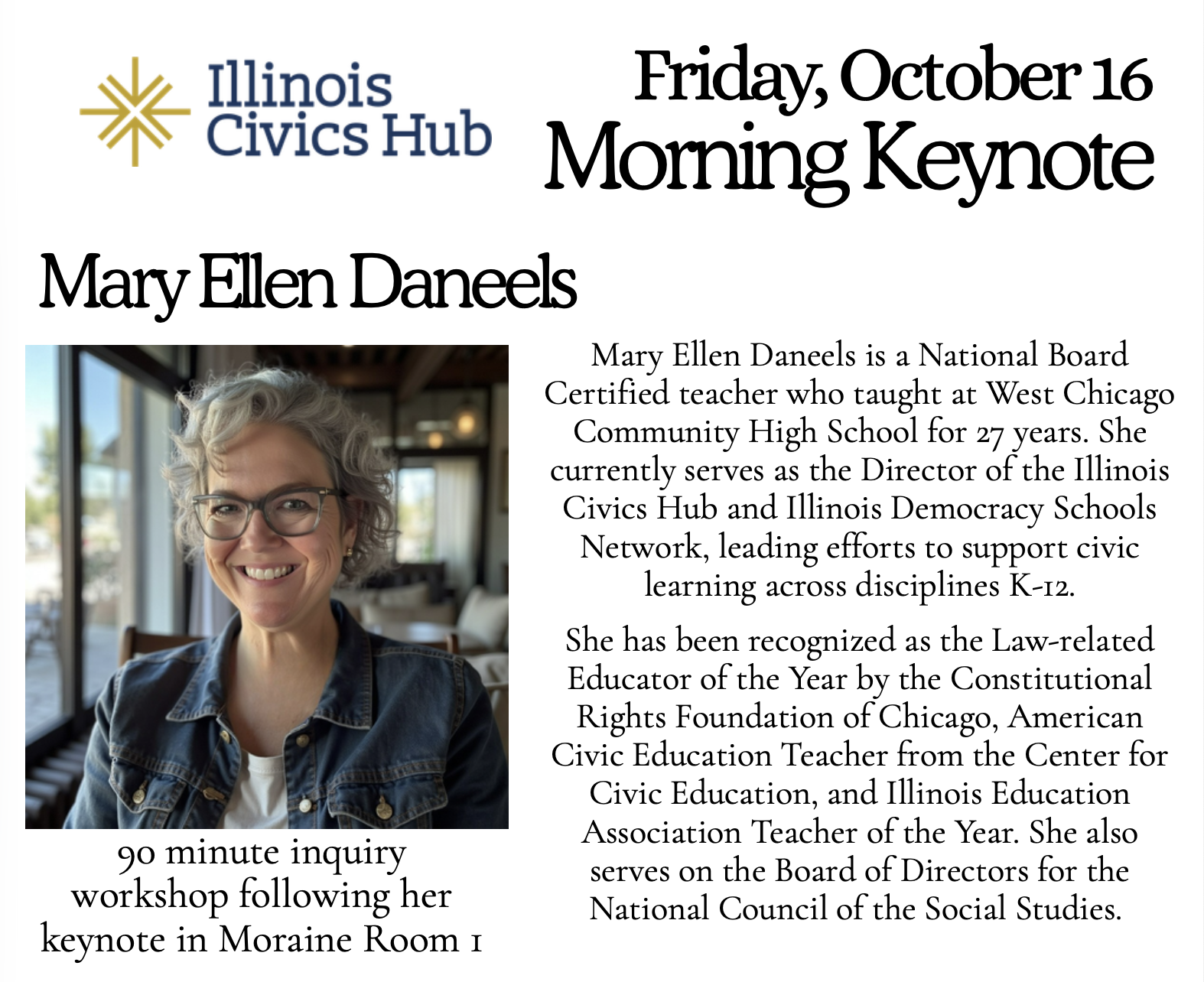
Mary Ellen DaneelsM202
English language arts classrooms are powerful spaces for students to practice democracy through reading, writing, speaking, and listening. Drawing on examples from Illinois Democracy Schools and youth community engagement projects, this interactive session explores how student voice, inquiry, and collaborative learning can strengthen literacy skills while fostering civic identity and agency. Participants will experience practical strategies for engaging students in meaningful discussions, evaluating sources, writing for authentic audiences, and connecting classroom learning to community issues. Through classroom vignettes and hands-on protocols, educators will explore how student choice, peer feedback, and shared decision-making can become everyday practices that foster belonging, critical thinking, and civic engagement. Participants will leave with adaptable routines and inquiry frameworks to help students imagine democratic futures—and recognize their own capacity to shape them.
Session Materials:
E Mariah Spencer, Anay Arreola, and Sofia StuartSponsor/Vendor Hall
What if the student—not the teacher, the curriculum, or the test—was the sun of the classroom solar system? Amid persistent concerns about student apathy, disengagement, and post-pandemic learning gaps, educators are reexamining compliance-driven models of instruction. This interactive poster session highlights the research, reflections, and clinical experiences of pre-service English educators who are re-centering their philosophical commitments around student agency in twenty-first-century classrooms. Using the extended metaphor of a solar system, the session reframes pedagogy: when students occupy the center, instructional strategies, assessment practices, and classroom structures orbit around their curiosity, lived experiences, and intellectual growth. Grounded in scholarship on student-centered learning, inquiry-based instruction, and culturally responsive pedagogy, the session moves beyond buzzwords to define what “student-centered” looks like in practice. Drawing on classroom-based inquiry, the poster features high-impact strategies that promote engagement and equity, including anticipation guides, Agree/Disagree protocols, Four Corners, K-W-L charts, metacognitive reflection routines, co-created curriculum design, performance-based assessment, and structured student choice. Brief comparisons among Montessori-inspired models, traditional U.S. schooling, and Finnish educational structures situate this work within broader philosophical and global conversations while remaining attentive to the realities of contemporary public schools. Designed for high school educators, pre-service teachers, and instructional leaders, the session offers adaptable lesson-planning moves and a clear conceptual framework participants can immediately apply. Attendees will leave with concrete strategies to increase engagement and a renewed lens for designing equitable, curiosity-driven classrooms in which every learner has gravitational pull.
Les LynnSponsor/Vendor Hall
Generative AI has upended the traditional English classroom. Students can now outsource summary, analysis, and even essay drafting to tools that produce competent prose in seconds. What AI cannot do is stand is present and defend original claims about literature or informational readings, weigh contested evidence in active dialogue with teens, and defend interpretive positions under live intellectual scrutiny. This is the domain of argument.
This poster presentation makes the case that argument-centered instruction (ACI) offers English teachers a coherent response to the AI moment—not by resisting the technology but by re-anchoring instruction in the live evidence-based reasoning and critical peer dialogue. Drawing on classroom work in Chicago-area high schools and beyond, and on the debatification framework developed by Argument-Centered Education, the poster maps the essential moves of ACI—debatable questions that coheres a unit, teaching content and skills through argument, and deploying argumentation formats that make learning visible — onto the specific literacies students now need: distinguishing generated text from earned thought, thinking critically about evidence and sources, and building interpretive positions they can actually own and defend.
Attendees will see concrete artifacts from partner classrooms, including debatable questions and selected passage sets for canonical and diverse literary texts, methods to maintain the viability of argumentative writing, and protocols that put AI in a productive rather than corrosive relationship with student thinking. The 15-minute presentation will close with a discussion of how English departments can begin retooling assessment and instructional planning around argument as the discipline's most AI-resilient—and most intellectually generative—commitment.
Session Materials:
11:15 AM-12:15 PM
Lauralee MossM201
If you've ever taken a glimpse at your curriculum and it seemed non-representative, this presentation will inspire you to add these dynamite female authors to your materials.
Lauralee Moss has taught for over twenty years in Illinois.
Session Materials:
Anne CloseM202
Effective teachers develop a reflective practice that allows them to review their classroom performance, make changes, and improve instruction. This is formalized as Classroom Action Research (CAR), a series of steps that guide teachers as they identify challenges in the classroom, research and enact potential solutions, and share their findings with their community. CAR is an important component of the tenure process at the City Colleges of Chicago; it is one of the methods we use to develop a reflective practice in our new full-time, tenure track faculty.
Unfortunately, adjunct faculty are often underserved by their colleges and lack the time, resources, and institutional support to develop their teaching in this way. My work in faculty development has revealed this to be a perennial issue—one that often prevents adjunct faculty from professionalizing to the extent that they become competitive applicants for full-time, tenure-track positions.
This presentation will review the principles of Classroom Action Research and the way it informs the tenure process at the City Colleges of Chicago before sharing my experience adapting this practice to support adjunct faculty at Truman College through a paid fellowship. The goal of this fellowship is to help adjunct faculty invest in their teaching practice, use research and peer consultation to address challenges in the classroom, deepen their reflective practice, and build curiosity and assignment about teaching.
Session Materials:
Mary Hilbert and Jason VanSwolM203
Our curricular development and expectations largely center on preparing students for college, but how do we meet the needs of students who have other post-secondary plans? With both aspirations for careers in the trades and university costs on the rise, this session will consider reading, writing, speaking, and research opportunities for students whose plans after graduation do not include academia.
In our district we continue to thoroughly prepare college-bound students. However, we have increased our explicit career readiness preparation including the National Career Readiness Certificate (ACT Workkeys).
This session will provide attendees with practical applications for single-student differentiation, whole class activities, long-range projects, and course design. There will be something for everyone who wants to address this need in ways both small or large.
Our work is rooted in research from NCTE, The College Board, and the U.S. Chamber of Commerce, as well as district-level data.
Session Materials:
Laura GilbertM204
Learn terminology and templates that you can teach your students to improve paragraph planning and essay outlining. This session will provide introduction and conclusion options, line of reasoning approaches, and practical strategies for incorporating corresponding, contradicting, and supplementing sources. Practice the authors’ dinner party activity with a College Board synthesis question source packet. Applicable to any kind of writing course, these methods of development can be especially effective for building confidence in AP Language and Composition students! Sample outlines and exemplar paragraphs will be available that you can use with middle school, high school, and first year comp students.
Session Materials:
Florian FeuchtM205
Discover a technology-based approach to strengthening students’ reading and critical thinking skills through differentiated instruction, creating an equitable learning experience for all students. This session showcases a suite of interactive videos that explicitly model disciplinary literacy strategies for students while tracking and adapting to individual student performance. These built-in formative assessments provide real-time feedback and personalized practice, allowing students to build skills at their own pace. This approach enhances student motivation, supports individual needs, and improves learning outcomes for students at all ability levels.
To extend learning beyond the videos, participants will explore a reliable, classroom-ready process that guides students in analyzing informational text, assessing sources, and evaluating credibility. Structured annotation activities reinforce these strategies through targeted practice with authentic texts, promoting transfer across content areas and future learning experiences.
Participants will leave with practical tools for modeling reading and critical thinking skills through differentiated instruction. They will take home materials, including a flowchart of the reliable process and a guide for annotating informational text. At the conclusion of the session, participants will discuss how these tools can be used and adapted in their ELA classrooms to improve learning outcomes for all students.
3:00 PM-4:00 PM
Kevin Long and Mary T. ChristelM201
Jan Kott argued in his landmark book, from which the session’s title is drawn, that Shakespeare’s works are not historical artifacts but vital texts, which speak powerfully to the present social and political realities for students to explore.
This session will present strategies to create a series of lessons revolving around speeches drawn from several plays to examine similar themes or “moments of crisis” which reflect and inform social justice challenges we face today. Then, this approach connects those themes and conflicts with contemporary poetry and prose which illuminate Shakespeare’s themes and conflicts, and vice versa. Join this session to workshop a speech from Shakespeare and a companion piece, which will prepare students for a more sustained experience reading one of the Bard’s plays and to recognize his impact on contemporary culture and thought.
As ELA instructors wrestle with which texts and voices to maintain in their curricula, Shakespeare has been an author whose place on the reading list was at one time sacrosanct, never to be eliminated. More recently the status of the Bard's work has come under closer pedagogical scrutiny. Is tackling a play in full or in part worth the time and energy? What are the transferrable skills and discernible appreciation students develop? This approach places Shakespeare in conversation with contemporary works, world events, and human concerns. It also provides students with reading strategies and analytical tools which can be applied to the analysis of a variety of challenging texts.
Session Materials:
Nicole Boudreau Smith, Norman Boyer, Angelo Bonadonna, and John HaywardM202
Student Teachers and New Teachers will have an opportunity to raise questions and to respond to others' questions about teaching, with comments by some teacher-educators as well. Here is a place to learn how others have handled issues you have about your experiences as a new or soon-to-be new teacher. Bring your questions!
Jason SchneiderM203
Students bring diverse linguistic backgrounds to the classroom, reflecting the many ways that language is used in society. Linguistic diversity can sometimes be seen as a pedagogical challenge, because teachers need to help all students achieve the same learning outcomes and standards, which are grounded in a very specific way of using language (Standard American English). However, from the point of view of sociolinguistics, a sub-discipline of linguistics, language diversity is not a challenge. Rather, it is a normal part of human societies that invites curiosity and appreciation.
This presentation addresses language diversity in the classroom in two ways. First, fundamental insights from years of sociolinguistic research will be shared, including the recognition that all ways of using language are equally rule-based, and that beliefs about the inherent superiority of Standard American English, or any other way of using language, are prescriptive social judgements, not descriptive linguistic judgements. Second, the presentation will review classroom approaches that English language arts teachers might draw on to reflect these sociolinguistic insights, without ignoring the fact that students need to use Standard American English effectively in order to achieve benchmarks and succeed on high-stakes assessments. Such approaches include making space for translanguaging in writing, integrating critical language awareness into content, and finding opportunities to valorize linguistic diversity in the classroom and society. Attendees will leave the session with new ways of thinking about language and new ideas for making their own classrooms more supportive of students from all linguistic backgrounds.
Adam Oldaker and Jen GrucaM204
Do you have some writing on hand that you’ve thought about trying to get published? Maybe a short story that you wrote for fun? A poem that captures something important to you? A strong scholarly essay that you wrote a few years ago? Perhaps you love reading and want to share your enthusiasm through reviews, or maybe you’re truly excited about a lesson or classroom project that went really well and you want to share details about it with other English educators. Whether you are a researcher, innovative teacher, fiction writer, poet, devoted reader, or aspiring author, this session is for you. Join the new editors of the Illinois English Bulletin as they provide an inside look at the oldest peer-reviewed ENGLISH EDUCATION journal in the United States. They will share its recent history, their vision for future issues, and tips for having your work accepted. They will also explain what happens behind the scenes after submissions arrive. What does it mean to have your work peer reviewed? What role does revision play in the publication process? What happens after a submission is accepted? Additionally, they plan to facilitate a brief writing workshop where you can get started on a new submission. Participants will leave with a clearer understanding of the publication process, practical strategies for preparing work for submission, and a concrete plan for developing a piece of writing for the Illinois English Bulletin.
Session Materials:
3:00 PM-4:30 PM
Sara FliehmanM205
In this interactive session, English teachers and school leaders will engage in a critical exploration of how white supremacist structures influence and shape the modern literacy environment. While the English classroom is a natural space for expression and storytelling, it is also frequently a site where systemic inequities are reinforced through traditional pedagogical norms and institutional expectations. Participants will critically examine how these structures influence classroom dynamics, participation styles, and the valuation of student voices. By identifying these deep-seated barriers, we will explore practical and immediate ways to disrupt these systems, fostering a culture rooted in genuine equity and inclusivity.
The session focuses on shifting the power balance within the school and classroom to ensure that the study of language serves as a tool for liberation rather than a mechanism for exclusion. We will delve into culturally sustaining strategies and equitable participation models that challenge the status quo, moving beyond surface-level inclusion toward a more profound systemic transformation. By analyzing effective routines that encourage active engagement and mutual respect, educators can dismantle the hierarchies that often silence marginalized perspectives.
Through this work, English educators can create transformative spaces where every person has meaningful opportunities to contribute and interact, building an inclusive community that honors the authenticity of each individual’s voice. Participants will leave with a clear, actionable framework to ensure their schools and classrooms become sites for systemic change, grounded in the continuous work of disrupting inequity and fostering dynamic, equitable engagement for all.
Session Materials:
Nicole Cordero / Dan FoutsM210
Combined Session (Overview)
Teachers have long recognized the primacy and critical necessity of classroom discourse—as James Britton observed, literacy "floats on a sea of talk." But how do we make that talking accessible, rigorous, and inviting to all students? In this combined session, veteran educators will demonstrate the potential of flexible tools that promote meaningful classroom discussion, including Four Corners, Real Talk, and Teach Different. Participants will try out these approaches for themselves, and leave the session with tried and true methods that they can immediately implement into a wide range of educational settings.
Session 1: Rethinking Participation: Designing Classroom Talk for Real Thinking
Classroom discussions often reward speed, confidence, and verbal dominance, which can unintentionally limit access to rigorous thinking for many students. Multilingual learners, neurodivergent students, and those who need additional processing time are frequently positioned as less participatory, not because of ability, but because of how discussion is designed.
This interactive workshop invites participants to rethink participation as a matter of instructional design rather than student disposition. Participants will engage in a Four Corners activity to surface how individuals process and participate differently in discussion, building a shared understanding of learner variability and its implications for equity.
Participants will then experience Real Talk, an equitable discourse strategy that structures academic conversation to expand student voice and agency without lowering rigor. Using a short text and a shared discussion prompt, participants will engage in the strategy as learners before stepping back to analyze the pedagogical moves that make it effective, including visible criteria for quality talk, protected processing time, interdependence, and discussion as formative assessment.
Grounded in insights from a collaborative PLC learning cycle across seven CPS high school English classrooms, this session emphasizes practical, classroom-tested approaches to designing talk that supports deeper thinking. Participants will leave with concrete strategies and time to plan one immediate classroom application that can be adapted across texts, grade levels, and student populations.
Session 2: Teach Different—Elevate Student Voice Through Conversations
This interactive workshop introduces educators to the Teach Different method, a practical, discussion-based protocol that elevates student voice through conversations. Participants learn how a simple change in their practice can create inclusive classrooms where students feel heard, challenged, and valued.
Participants will experience a live model discussion centered on a powerful quote, then unpack the Teach Different method step-by-step and have time to brainstorm how to adapt it to their classrooms. Participants receive a curated list of powerful, classroom-ready quotes to support ongoing use of the method.
Session Materials:
Presenter's Note to Attendees: Thank you so much for joining my session today! I hope you found some ideas and strategies you can bring back to your classroom. You can make your own editable copies of the resources linked on slide 27. I'd love to hear how you use them, so please keep in touch!
3:00 PM-3:15 PM
Deborah Althoff WillSponsor/Vendor Hall
As a high school librarian I began researching the methods and strategies promoted by the researchers promoting the Science of Reading, and I realized that there was very little I could do to explicitly teach these strategies in the high school setting; however, I also recognized that my students required the skills that the researchers were discussing. Therefore, I began searching for a strategy that would teach the skills in the library setting, and I found a variety of board games that teach literacy skills. I chose several of the games and placed them in the library to see if students would interact with them (and with each other) daily. We found that student engagement increased exponentially. Library attendance also doubled. Additionally, we found that students were engaging in more conversation, were participating in more creative endeavors like puzzles and painting, and were reading more books than in previous quarters.
4:15 PM-5:15 PM
Carrie Santo-Thomas and Blake ThomasM201
This session showcases a secondary ELA unit built on an ambitious premise: give students choice, agency, and a genuine stage for real thinking. Students analyze what makes a canonical work endure, then evaluate whether contemporary or more accessible texts accomplish similar thematic and stylistic work. The canon isn’t discarded, but rather interrogates and expanded with intention.
It expanded into tabs. So many tabs. Documents wandered. Bibliographies stalled at “three sources and a dream.” Collaboration became… interpretive.
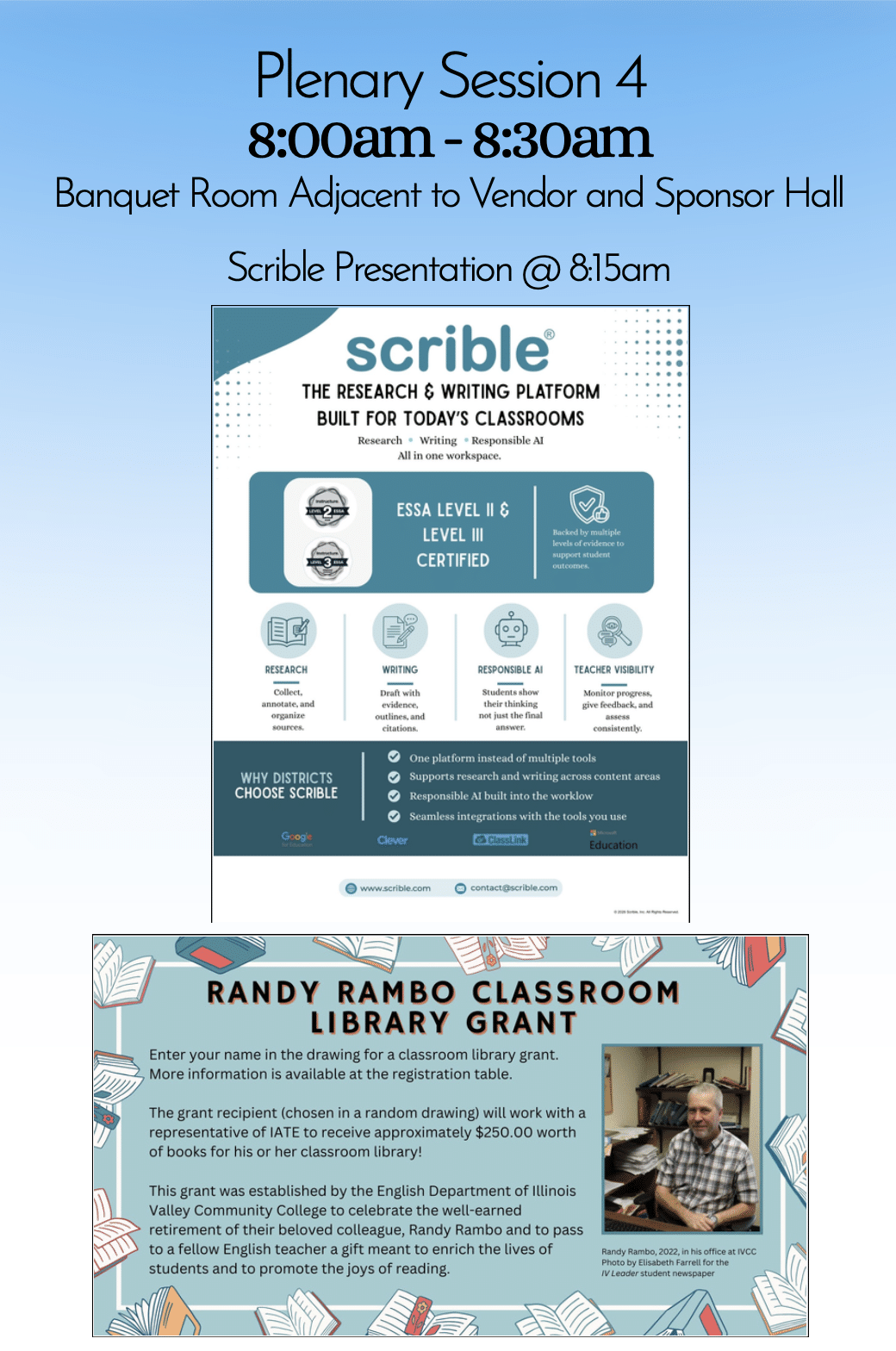
This iteration introduced Scrible as the structural backbone of the inquiry process. Annotation, source organization, citation management, and progress visibility live in one space, allowing classroom energy to shift from document-herding to idea-building.
The result is a unit where students practice real research moves: tracking claims, evaluating credibility, constructing arguments, leaving teachers to focus on instruction, differentiation, and the messy joy of literary debate.
Session Materials:
Note to Attendees: Access our slide deck at the link provided! Ashton can be reached at ashton@scrible.com if you'd like more information about Scrible!
Jane Schumacher and Mindy RotmanM202
In this session directed towards teachers of high school English, participants will receive several strategies to spark the thinking and engagement of students who struggle with literacy-based anxiety. This session will explore several strategies from Jane Kise’s book, Doable Differentiation, as well as applications of research from Professor John C. Hawkins at Illinois State University that have been most effective in getting students “unstuck” in the face of overwhelming reading and writing tasks. Presenters will share resources to support implementation of these strategies as well as provide practical examples of how these strategies have worked in their classrooms. Participants will engage in one simulated reading and writing activity and will leave with strategies and resources to help get anxious readers and writers out of their heads and into the text.
Session Materials:
Cindi KoudelkaM203
In a world of sound bytes, memes, and instant information, how do we help students ethically navigate it all to connect, rather than divide, our society? We must rethink our support for that work and examine how the transformative power of digital literacy and AI —often perceived as nothing more than a cold, mechanical form of cheating—can actually foster our students’ most human traits: empathy, critical thinking, agency, and community building. Explore how the ISTE Standards for Educators and Students support both academic learning and social-emotional growth, offering a framework for more equitable, student-centered classrooms. Through practical examples, we will examine how inclusive literature, various digital and AI resources, assistive technologies, and accessible platforms can be intentionally integrated into authentic learning opportunities that shift who participates, whose voices are amplified, and how students make meaning across print and digital worlds. Engage in strategies that empower students to produce, interpret, communicate, and collaborate critically, bridging literacy, technology, and humanity. The session highlights ways to design authentic learning experiences that honor diverse identities, abilities, and ways of knowing while preparing students to participate thoughtfully in a digitally mediated society. Whether you are a tech-savvy innovator or just beginning to embed digital tools into instruction, this session invites you to rethink digital literacy as an equity-driven practice—one that energizes teaching, centers students, and transforms classrooms into spaces of connection, agency, and possibility.
Session Materials:
4:15 PM-5:45 PM
Renee SundayM204
Educators shape equitable classrooms while balancing academic expectations, grading demands, student emotional needs, and institutional pressures. Sustained overload can reduce instructional clarity, consistency, and student engagement, especially among diverse and underserved learners.
This session introduces practical strategies grounded in the REST Framework, a structured approach designed to support educator performance, instructional effectiveness, and classroom equity. Participants will explore methods that strengthen communication clarity, grading consistency, and student participation while supporting sustainable teaching practices.
Attendees will gain classroom-ready strategies that support inclusive instruction, improve student engagement, and support long-term educator performance without increasing workload demands.
Session Materials:
8:45 AM-9:45 AM
Kathryn Creasy / Oluwatodimu OgunadeM201
Combined Session (Overview)
Rethinking ELA begins with creating meaningful space for students to explore who they are, what they believe, and how they make meaning of the world around them. Through authentic writing, multimodal literacy, imagination, and community-engaged practices, this session offers pedagogical moves that center student voice and identity while strengthening critical thinking and social-emotional learning. Participants will engage in hands-on, collaborative activities and leave with concrete strategies and adaptable resources for making literacy more purposeful, creative, and equitable.
Session 1: I Believe: The Power of Students’ Beliefs
In this session, I plan to present a lesson that gives students opportunities to share their beliefs and thoughts on the world through a variety of genres. This encourages students to write authentically and encourages them to not rely on AI to think for them. These genres promote social-emotional learning. Some of the genres covered would include: I believe poems, This I Believe (the podcast), Moth stories, Mortified, and TED Talks. Students value these lessons and hold onto them. Through these exercises, they learn to value and reflect on their thoughts, feelings, experiences, memories, opinions, and beliefs. I will share not only the impact on the students and the beauty of what they create through these genres, but I will share the lasting effects of giving the students these opportunities. I will provide examples, templates, and more with my peers, so that they can take what I have and construct their own lessons. The product is a snapshot of students’ lived beliefs at a particular moment in their lives. It can also help students with critical analysis and identifying, respecting, and understanding beliefs that may be different from their own.
Session 2: Reimagining ELA: Centering Identity, Imagination, and Innovation in Literacy Classrooms
As educators in English language arts, we teach during a time influenced by significant social shifts and advancing technological development. Amid these changes, students’ sense of themselves as readers remains foundational to their long-term relationship with literacy. Studies show that as students advance through grade levels, their interest in reading often diminishes, especially when instruction emphasizes discrete skills at the expense of personal connection, imagination, and authentic meaning-making. If we approach the future of ELA with intention and possibility, we must consider how our classroom practices influence students’ perceptions of their own capacities and identities as readers, writers, and communicators.
Grounded in sociocultural perspectives on literacy, identity formation, and learning, this session encourages educators to reconceptualize ELA classrooms as spaces of creativity, possibility, and affirmation. Participants will engage in hands-on, collaborative activities that demonstrate adaptable instructional approaches, including:
Participants consider the role of imagination as a catalyst for innovation in ELA instruction and examine how intentional pedagogical changes can reshape students’ perceptions of themselves as readers. The session concludes with concrete strategies, reflection protocols, and actionable ideas for cultivating literacy spaces where reading is experienced as purposeful, creative, and enduring.
Randi Smith and Ami McConnellM202
Discover the inspiring journey behind Ada Holloway’s Had Enough (April 21, 2026, Amethyst Books, 978-1-970757-03-3), a YA novel born in a college classroom and shaped by mentorship, advocacy, and the fight for intellectual freedom. Co-presenters Sara Wigal, Associate Professor & Director of Publishing at Belmont University, and author and Library Staff at Daviess County Public Library, Randi Smith share how a class assignment evolved into a debut novel tackling book bans, generational divides, and the power of empathetic conversation. Learn how fiction can model healthy conflict resolution, empower teens to speak up, and spark meaningful dialogue about censorship. This session blends storytelling, education, and practical strategies for libraries and educators.
Angela GallM204
Emerging writers can be overwhelmed by the idea of crafting their own stories. Gifting them ready-to-use tips frees them from writing anxiety. It’s amazing to witness the immediate growth in students’ work when they apply these tips. Providing writing tips to young writers is the great equalizer. Every student is given the opportunity to succeed because they are taught the tools they need to do so. Many students feel like writing is this mysterious thing that only the brightest can achieve, but with 25 Tips at their fingertips, they can rewrite their future.
Session Materials:
Daniel YunkerM205
Middle school students are far more likely to engage deeply when they understand why learning matters to them. In ELA classrooms, relevance is not simply a motivational tool—it is an equity-centered pedagogical move that creates access, ownership, and voice for diverse learners.
This breakout session focuses specifically on the middle school classroom and explores how relevance-driven instruction can increase engagement, especially among students who may feel disconnected from traditional literacy tasks. Drawing from experiences teaching an 8th grade Future Career Unit at Evans Junior High School, this session will highlight how connecting reading, writing, discussion, and inquiry to students’ identities, interests, and future aspirations can transform classroom energy and participation.
Participants will explore practical strategies such as career-based writing prompts, student-choice discussion protocols, identity-linked mentor texts, collaborative inquiry tasks, and real-world literacy applications that make ELA learning feel immediate and meaningful. The session will also address how relevance supports equitable participation by honoring multiple pathways into learning, particularly for middle school students navigating questions of self, belonging, and future possibility.
Attendees will leave with concrete lesson ideas, adaptable engagement routines, and a framework for designing middle school ELA experiences where rigor is strengthened—not reduced—through relevance.
Cindi Koudelka, Julie Hoffman, and Melissa WheelerM203
“There was something freeing about envisioning a future wrought with undiscovered possibilities; understanding a universe beyond the immediate realm of my real-life experience; and imagining innovations that could impact how the current world shifts and changes” (Toliver, 2026). The freedom she describes becomes possible when students have access to inclusive texts that reflect their joy, strengths, and lived experiences. Such texts invite young people to imagine just futures, innovate new ways of being, and inspire others to join that work.
Each day, students enter our classrooms carrying ideas that can either be illuminated or extinguished. When inspired, they imagine futures without limits. Acts of literacy—particularly those rooted in imagination and innovation—become acts of liberation. Students who experience constraints imposed by society or by bodily/neurological variance can find refuge in stories that honor humanity’s most transformative moments, all born from imagination. From ancient narratives to emerging technologies, individual and collective dreaming fuels change.
Inviting students to critically interrogate inclusive texts and classroom discourse around justice creates space for transformative voice and agency. As Freire reminds us, the teacher’s role is not to dictate meaning but “to make it possible for the students to become themselves” (Horton & Freire, 1990, p. 145). Social dreaming, central to critical literacy, apprentices students to recognize power, disrupt oppressive narratives, and imagine alternative futures.
Providing access to literature that celebrates differences in bodies, minds, and abilities is an act of liberation. Therefore, this session highlights the power of story to affirm identities, amplify marginalized voices, and foster belonging. Presenters will share strategies for integrating inclusive texts, examining authentic representations of bodily/neurological variance, creating affirming classroom spaces, and curating comprehensive book lists that empower students to lead the way forward.
Session Materials:
8:45 AM-10:15 AM
Olivia MulcahyM210
Free Write is a creative space for educators to connect, generate ideas, and share inspiration through writing. This session is an opportunity to experience Free Write—a monthly, online workshop—live and in-person! The form in focus: Translanguaging poetry!
Translanguaging is the natural way bi/multilingual people use all their language practices fluidly to communicate, make meaning, and express themselves—mixing languages and language features rather than keeping them strictly separated. Translanguaging poetry can open the door for powerful exploration of bilingual experience and community, potent metalinguistic conversations, and deep development of literacy—leveraging every communicative asset to enhance what we can do in English Language Arts.
The session is intended to deepen educators’ own understanding of bilingual experiences and identity, invite reflection on linguistic equity in curriculum, and amplify teacher’s repertoire of translanguaging/poetry strategies that can be used practically in many grade levels, content areas, and interdisciplinary settings
In this session we will
10:00 AM-11:00 AM
Sarah RosasM201
A welcoming, inclusive, and equitable classroom accounts for student differences and makes learning accessible regardless of a student’s starting point. This is the perennial challenge for high school teachers who assign readings to a diverse range of students. They ask themselves, “How can I ensure that all my students will learn at high levels regardless of their reading skills?” and “How can I meet my students where they are while utilizing one text?” The answer lies in some simple, sustainable shifts. By utilizing targeted and systematic scaffolding, we can better match readers to text in order to grow their skills—in a way that is manageable and sustainable for teachers.
Join me to consider the intersection of best reading practice and differentiated instruction. Using “The Road Not Taken” as our sample text, we’ll focus on before and during reading strategies to differentiate both content and process in order to address varying student needs in a way that is not only appropriate for a short poem but also for longer texts, including novels. Participants will walk away with a stronger understanding of how reading comprehension occurs, the reading challenges our students face, and manageable, immediately actionable ways to support them as they wrestle with complex texts.
Session Materials:
Guadalupe RamirezM202
As schools increasingly replace full-length books with excerpts, students lose opportunities to build reading stamina, inhabit complex perspectives, and follow ideas across an entire narrative. This session shares a secondary, cross-curricular ELA unit integrating art and social studies that pairs full-book literature circles with student ownership, visible accountability, and civic action.
Students read novels centered on love, home, displacement, family, and community, then made their thinking visible through character text threads, group chats, Instagram-style posts, multimedia bell ringers, “Spill Session” conferences, and student-led discussions. These routines allowed students to decide what mattered in a text while giving the teacher concrete evidence of comprehension, interpretation, collaboration, and growth. They also cultivated empathy, curiosity, persistence, social intelligence, and adaptability.
The work then moved beyond literary analysis. In the following unit, students used themes of borders, belonging, survival, and solidarity to identify a barrier in their school or community and create a public-facing or digital “Borders to Bridges” action project designed to disrupt it. Their projects addressed issues such as school discipline, locked bathrooms, belonging, family separation, migration, public safety, and who is treated as worthy of protection.
Student co-presenters will share how the work shaped their reading, creative expression, discussion, and civic imagination. Together, presenters will offer a transferable unit arc, practical routines for sustaining full-book reading, examples of writing mini-lessons, and strategies for helping students move from reading stories to questioning conditions—and acting on what they learn.
Session Materials:
Presenter's Note to Attendees: I would love to hear your ideas if you play with any of these things :-) Lupe Ramirez (turbolupe@gmail.com)
April Davenport, Sierra Strawder, Ashton Davidson, and Lynda LandesM203
The first-grade team at Thomas Metcalf School is transforming education through a collaborative teaming model inspired by the Next Education Workforce initiative. Three core teachers and one teacher assistant work together to support 54 first graders. By rethinking traditional classroom structures and teacher roles, we have transitioned from isolated classrooms to shared responsibility of students, instruction, and outcomes.
Our team plans together and intentionally differentiates phonics instruction across flexible groups. Reading and writing are taught whole-class, ensuring all students have access to grade-level instruction, followed by workshop time that fosters student independence while allowing teachers to provide targeted small-group support. This approach creates more equitable learning opportunities by responding to student needs in real time.
Preservice teachers and interventionists are embedded within the team, increasing instructional capacity and strengthening feedback. Each Friday, the team analyzes student data and intentionally forms and adjusts groups, ensuring instructional decisions are responsive rather than fixed.
Teaming like this has been impactful. Assessment data show strong growth, teachers know all students well, and shared planning and defined roles reduce stress while increasing effectiveness. Students benefit from flexible grouping and meaningful relationships with multiple adults, contributing to a more inclusive and equitable classroom experience.
Participants will gain a fresh perspective on teaching and learning that breaks down silos, addresses teacher burnout, and supports meeting the needs of all learners. Our presentation offers practical teaming models, data-driven grouping strategies, and actionable ideas that educators can adapt to make collaborative, equitable teaching work in their own schools.
Jeanne' Aken and Nichole FolkmanM204
Come to hear this booktalk session of the newest Rebecca Caudill Young Reader's Book Award and Lincoln Award titles. These student choice awards are a perfect way to allow student choice in your learning environment. Descriptions, strengths and target audience for a wide variety of books. Learn a little about the awards themselves, and how you can introduce these titles to your students.
Session Materials:
10:00 AM-11:30 AM
Sofia GonzalezM205
In the quest to create more equitable classrooms, global competency must be reimagined not as an add-on but as a foundational pedagogical move—especially in bilingual English settings. This session explores how educators can rethink instruction to center students’ languages, identities, and lived experiences while cultivating global awareness.
Grounded in culturally sustaining pedagogy and equity-centered practice, participants will learn actionable strategies that integrate global competency into bilingual and English classrooms serving multilingual learners. By amplifying student voice, connecting local and global issues, and valuing linguistic assets, teachers can disrupt deficit narratives and foster classrooms where all students thrive as critical thinkers and global citizens.
Through interactive reflection and real classroom examples, participants will leave with tools to enact equitable, transformative pedagogical moves that prepare students to engage meaningfully with the world beyond the classroom walls.
Teachers will also receive resources to travel abroad and engage global experiences to enhance best practices.Sofia Gonzalez
Session Materials:
Notes: Go to https://linktr.ee/Sofia_Gonzalez to access slide deck.
Rachel StowersSponsor/Vendor Hall
GenAI has experienced rapid growth and controversy over its benefits, drawbacks, and ethicality in education. This study examines Illinois educators’ attitudes and classroom use of GenAI across middle school, high school, and higher education. Data was collected through a digital survey containing quantitative and short-answer questions, yielding 330 respondents who were practicing teachers, along with five supplemental interviews. Preliminary results show that respondents ages 20–29 reported the highest understanding of how to use GenAI yet were also the most likely to express ethical discomfort, with 45.9% disagreeing that they feel comfortable using it ethically. While responses varied, educators generally viewed student use of GenAI more negatively and fearfully than teacher use. These findings deepen understanding of teachers’ current views and practices with this emerging technology and highlight the need for clearer guidance, professional learning, and classroom policies to support ethical GenAI integration.
Caty Siefert-PearceSponsor/Vendor Hall
This session delves into the popular form of podcasting and how to use it in place of a standard research paper. Podcasts are typically short, serialized audio pieces that can, but do not have to be, collaborative. In the age of AI and waning student engagement, these pieces can become invaluable in teaching research writing and making it relevant to students' interests today. In this session, participants will be given tools and ideas for how to model and rhetorically analyze professionally produced podcasts, what students can take away to adapt from those podcasts to their own, how to take tried and true research essay writing practices and apply them to this genre, as well as tips for having students record their pieces from the outline/script they produce.
E Mariah Spencer, Michelle Robinson, Casey Brucks, and Macy PappM201
This open discussion session centers on the challenges, hopes, and strategies for success in teaching. Student teachers and educators in their first few years of service are invited to share both challenges and victories, while experienced teachers and others who support novice educators are encouraged to attend and contribute their insights.
During this session, student teachers will share their experiences researching and teaching the epic poem Beowulf, taking on the challenge of making this thousand-year-old text relevant and engaging for 21st-century students. Their work reflects a broader effort to rethink education through pedagogical moves that promote more equitable classrooms, including inclusive strategies, student-centered inquiry, and the use of multiple lenses to invite all learners into complex texts. Attendees will hear about both successes and struggles and engage in conversation about how thoughtful, equity-minded teaching practices can support novice teachers and the students they serve.
Session Materials:
James KennedyM202
The 90-Second Newbery Film Festival is a video contest, culminating in live events, in which young filmmakers are challenged to create short videos that compress the entire story of any Newbery Medal or Honor winning book in just a few minutes. Creative twists are encouraged—Charlotte's Web in the style of a horror movie, for instance, or The Tale of Despereaux in the musical style of Les Miserables—and adult help is okay. The aim of this program is threefold: (1) To entice students into reading and discussing Newbery award winning books—including older, unjustly obscure titles; (2) To encourage the close, intelligent reading necessary to write a script that wittily sums up an entire book in a very short movie; (3) To give an opportunity for students to use new technologies, such as video equipment and video editing software, in a constructive way that promotes literacy. The best videos received are showcased at annual 90-Second Newbery Film Festival screenings in New York City, Chicago, San Antonio, Minneapolis, and many other cities across the U.S. These free events combine screenings of the movies with live Newbery-themed entertainment, co-hosted by film festival founder and children’s author James Kennedy and other and award-winning childrens authors such as Jon Scieszka, Rita Williams Garcia, Jenni Holm, and more. In this session, we will share some of the most best 90-Second Newbery videos and share best practices for making 90-Second Newbery videos at your school, and even putting on one's own screenings.
Julie Hoffman, Jennifer Brooks, Melissa Wheeler, and Cindi KoudelkaM203
Join us as we share our favorite books that center and celebrate Black Joy in Literature! We will highlight joyful, identity-affirming literature that spans all ages in a fast-paced book talk. Links to purchase books from black-owned independent book stores will be provided! Books will be on-site to explore! Door prizes will be given! Come and make a new TBR list for your classroom with us! Representation matters—and joyful Latine stories transform classrooms for all students. This session shares fresh, creative ways to bring vibrant Latine books into novel studies and classroom libraries. Participants will learn about high-quality books featuring Latine representation, activities to support them, and actionable ideas to amplify student voice, pride, and literacy through authentic voices.
Session Materials:
Amber Robins, Kara Turley, and Kristin Schrewe / Jennifer GiangregoM204
Combined Session (Overview)
In this session, you will learn how to shift the conversation from talking about ways to detect students’ use of AI to talking with students about the ethics of AI. You will also learn from an educator who redesigned a composition course by intentionally creating community and encouraging personal writing to reduce the reliance on AI.
Session 1: Dialogue Before Detection: Honest Conversations with Students about AI
Instead of losing planning time to revision histories and detection tools, what if we invested that time into reshaping the conversation about AI with our students before they even turn something in? This session invites educators to explore the ethics of AI alongside their students and encourage students to take the lead. By shifting the focus from “catching” students to conversing with them, students will not only have more voice and agency in their education but also become more ethical users of AI. In this session, three educators will share how they started that shift in their own classrooms and school community by dialoguing with their students, organizing student-led discussions that were later shared with faculty, and dedicating class time to exploring the ethics of AI. During this session, participants will learn about this shift at their school with student-led discussion videos, professional development designs to engage faculty as well as providing resources, lessons, and activity ideas. The future of AI in schools will be determined, not by the tools we restrict, but by the conversations we share with our students.
Session 2: From Product to Process: Rethinking Composition I in the Age of AI
Over the last year, I have realized that most of my essay assignments in Composition I were ones that were perfect to feed into ChatGPT. At first, I was resentful. However, then I began to see it as an opportunity to create new assignments that students would care about writing, and I would find interesting to read. After growing tired of policing students, especially in my online courses, I redesigned my Composition I course to focus less on the final product and more on the writing process, student voice, and community, while still fully meeting IAI requirements.
One of the biggest shifts I made was redesigning essay assignments to center on personal writing, students’ experiences, observations, and reflections, while still teaching academic skills like thesis development, organization, evidence, and revision. I also built in intentional community-building activities during the first few weeks of the semester. Creating that classroom community early on helped students to feel more comfortable about sharing their writing later in the semester.
Throughout the semester, I added more opportunities for student self-reflection, asking students to reflect on their drafting process, peer feedback, and revisions. To support this shift, I moved to a standards-based grading system, which made grading more transparent and equitable.
Finally, I replaced a traditional final essay or exam with a multimodal project that allows students to combine visual, audio, and written elements while reflecting on their development as writers over the semester.
This session will share practical strategies, assignment ideas, and grading approaches that instructors can adapt for both high school and college composition classrooms.
Session Materials:
Nyssa KontnyM210
Designing meaningful learning in ELA classrooms requires more than strong texts and thoughtful intentions; it requires an instructional architecture grounded in how the brain encodes, stores, and retrieves information. This session presents a practical, neuroscience‑aligned framework that supports English teachers in designing instruction that “sticks” by intentionally activating multiple neural pathways — visual, linguistic, spatial, auditory, and conceptual — to strengthen encoding and long‑term retention.
Participants will examine how core principles from cognitive science — including dual coding, multimodal input, retrieval practice, and metacognitive discipline — can be translated into everyday ELA instruction without adding complexity or time. The session also highlights how interdisciplinary and thematic pedagogical design amplifies these effects by giving students coherent conceptual anchors that deepen schema activation and promote transfer across texts, genres, and content areas. Drawing on examples from reading, writing, and discussion‑based learning, the session demonstrates how strategic design moves such as spatial organization, memory loci, and concept‑mapping structures create stronger, more durable neural networks that enhance comprehension and long‑term understanding.
The session emphasizes how intentional multimodal and interdisciplinary design reduces cognitive load, supports conceptual coherence, and builds the interconnected pathways that help students retain ideas across units and contexts. Attendees will work with adaptable templates and planning tools that support lesson and unit design aligned with how the brain learns best. By the end of the session, educators will be equipped with a clear, flexible design process they can apply in their own ELA contexts — one that leverages multiple neural pathways, strengthens metacognitive discipline, and builds the robust memory architecture necessary for lasting learning.
11:15 AM-11:30 AM
Oluwatodimu OgunadeSponsor/Vendor Hall
Imagine a classroom where teachers use collaboratively developed student social narratives to address meaningful social situations. Social stories are short, didactic narratives that communicate behaviors, expectations, or skills, helping students make sense of social norms. Unlike traditional children’s literature, which often addresses emotional development on a broader level, collaboratively written social stories are personalized and grounded in a class's shared values and lived experiences. For example, after reading a story about teamwork, students may work together to write a social story that defines what teamwork looks like in their own classroom, supporting a deeper understanding of the concept.
Collaborative writing of social stories serves as a practical tool for developing both social-emotional and practical skills. Students learn targeted social skills while also practicing narrative writing, patience, and flexibility. These stories engage students across grade levels in socially relevant topics, from following recess rules in kindergarten to respecting differences and identities in fourth grade or advocating for recycling initiatives in seventh grade. This approach promotes student-centered learning that integrates social justice themes, encourages students to support their communities, and uses writing to engage with each other.
During this session, participants will reflect on social challenges they face in their classrooms and collaboratively create a social story addressing one such issue. Participants will leave with practical practices for incorporating student-centered narrative writing into their literacy curriculum, along with adaptable approaches that can be applied across multiple developmental levels.
3:00 PM-4:00 PM
Heather CrivilareM201
Your literature unit went well, so why are the essays terrible? This session introduces a clear and practical framework that helps students move from noticing what's meaningful in the reading to writing confidently about what they find.
We’ll begin by uncovering common obstacles that prevent deep literary thinking, then explore a scaffolded sequence of support that builds analytical confidence step by step. Whether you’re helping freshmen move beyond plot or coaching AP Lit students to articulate authorial intent, this approach meets students where they are and shows them how to grow.
You’ll leave with a map of key subskills to target, examples of how to scaffold commentary and textual evidence, and classroom-ready ideas for supporting analysis at any level. This session is both realistic and ready to implement.
Participants will also receive a free resource and links to additional tools that align with the framework.
Session Materials:
Kelly Vaughan, Mark Letcher, Amy Lilek, Guadalupe Ramirez, Shannon Tierney, and Norma MayaM202
In this session, six participants would share ways they plan learning activities to engage learners with meaningful texts. Our presenters represent a range of experiences and institutions and include two professors of English education, two practicing English teachers, and two preservice teachers.
Each presenter will focus on pedagogical practices for one of their favorite texts, including A Raisin in the Sun (Lorraine Hansberry), Macbeth (William Shakespeare), Nature (Ralph Waldo Emerson), Parable of the Sower (Octavia Butler) and Shadowshapers (Daniel José Older). We will discuss text selection (including using graphic novel versions of some texts), connecting texts to students’ cultural, community, and personal assets, curating differentiated text sets, and utilizing supplementary materials.
Katherine Alford / Mark Brand and James DrownM203
Combined Session (Overview)
Can students articulate what counts as "writing"? What about storytelling?
Teachers can invite students of all ages into breaking out of the typical writing box through an assortment of activities that yes, brings engagement, but also expands where and when students write. More than creative writing, this session will provide hybrid assignments such as hashtags & other social media postings, infographics, comic strips, recipes/nutrition labels/menus, and how-to books while covering analysis and issues of authorship and media literacy.
Teachers will leave with activities that stretch what "counts" as writing.
Session 1: Multi-Modal Writing to Engage Reluctant Writers in Creation
Description: This session will provide multiple opportunities for current and future middle grades and secondary ELA teachers to write in multimodal formats and develop writing assignments that ask students to think beyond traditional writing formats. It will expand our notion of what "counts" as writing and demonstrate, through student examples and hands-on learning, how we, as teachers, can help disengaged writers deeply engage in writing that is relevant, creative, fun, and purposeful.
Relevance: This session is designed to break out of the traditional writing box and expand both our and our students' conceptions of what is "writing." It offers opportunities to reimagine current writing in a more engaging, creative, and purposeful manner to get even the most reluctant writer writing.
Contributions: This session will share multiple ideas for writing assignments, including, but not limited to, hashtags & other social media postings, infographics, comic strips, recipes/nutrition labels/menus, and how-to books.
Session 2: Video Games in the Writing Classroom: Game Selection and Lesson Structures
The intellectual curiosity we expect of strong incoming college students often hinges on factors such as curriculum accessibility, received knowledge, and familiarity with discourse but, fortunately, whether we’re teaching seasoned, engaged writers or the most tentative beginners, one truth unites them: no one is afraid of Pac Man. For years we have taught video games in our respective classrooms as rich, approachable texts worthy of formal analysis and scholarly interpretation. But what makes a game suitable for teaching, and what sorts of lessons can be taught with them? Games offer an inviting pathway to writing exercises that can be immediately applied to other texts, and they are themselves meaningful texts of 21st century culture. Grounded in the theory of Stephen Greer, Bo Ruberg, Roland Barthes, Michael Foucault, Sherry Turkle, and Jane McGonigal, we highlight four classroom-friendly video games (Pac Man, Queers in Love at the End of the World, One Night, Hot Springs, and That Dragon, Cancer) and our lesson structures for teaching a variety of writing-focused skills with them: concrete and abstract detail, narrative and ludic textual layers, social-semiotic analysis and issues of authorship and media literacy, collaborative group work, and answering bigger philosophical questions like “can empathy be taught?” and “what makes a text art?”
Session Materials:
3:00 PM-4:30 PM
Anoa AlimayuM204
Walk through a four-stage roadmap that gets every student comfortable speaking up. Bring a personal lesson to update, and leave with a ready-to-use digital toolkit that makes student discourse an easy, daily habit.
Session Materials:
The 2026 IATE Fall Conference, Rethinking Education: Pedagogical Moves to Create a More Equitable Classroom, takes place Friday, October 16 and Saturday, October 17, 2026, at Moraine Valley Community College in Palos Hills. Here’s everything you need to find your way to campus, park, and settle in.
| 7:30 a.m. | Registration opens; light breakfast in the Exhibition Hall |
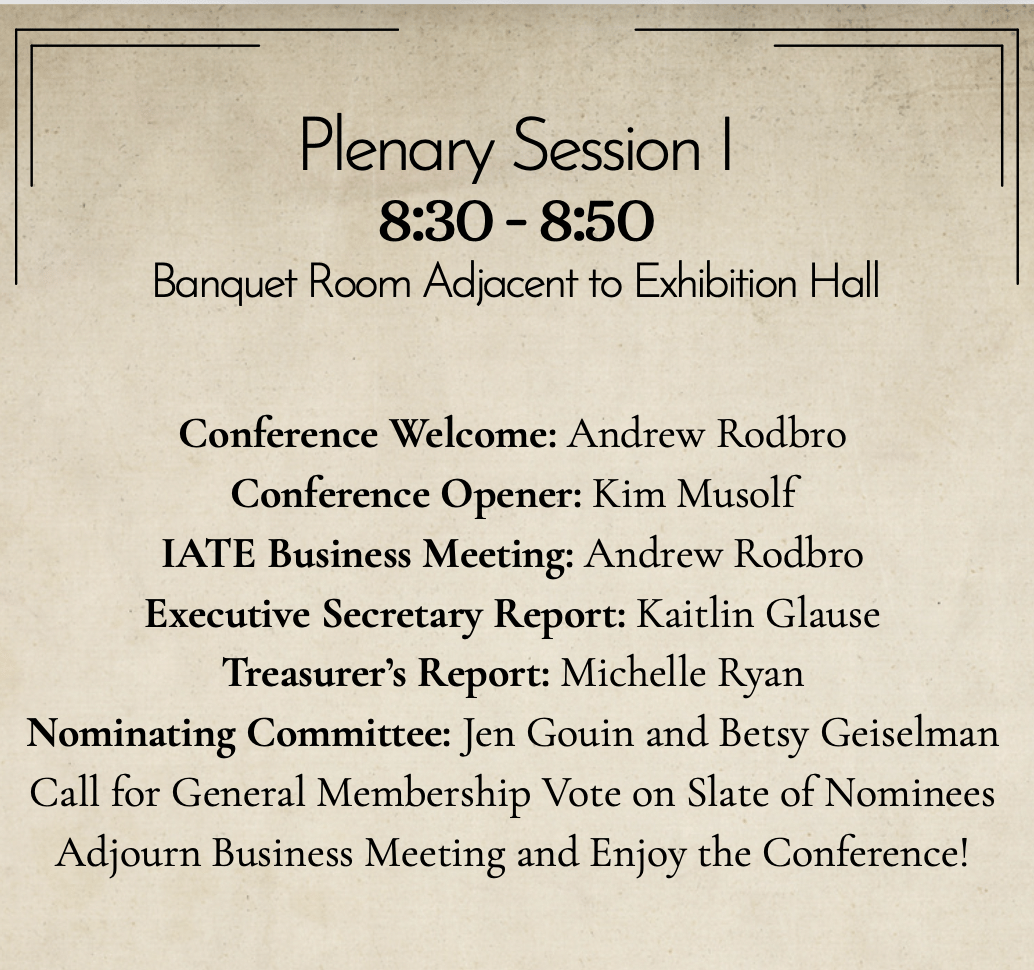
| 8:30 a.m. | Plenary Session 1: Welcome and IATE Business Meeting |
| 9:00 a.m. | Opening Keynote: Mary Ellen Daneels, followed by a 90-minute inquiry workshop in Moraine Room 1 |
| 10:00 a.m. | Poster Presentations A and Breakout Session A |
| 11:15 a.m. | Poster Presentations B and Breakout Session B |
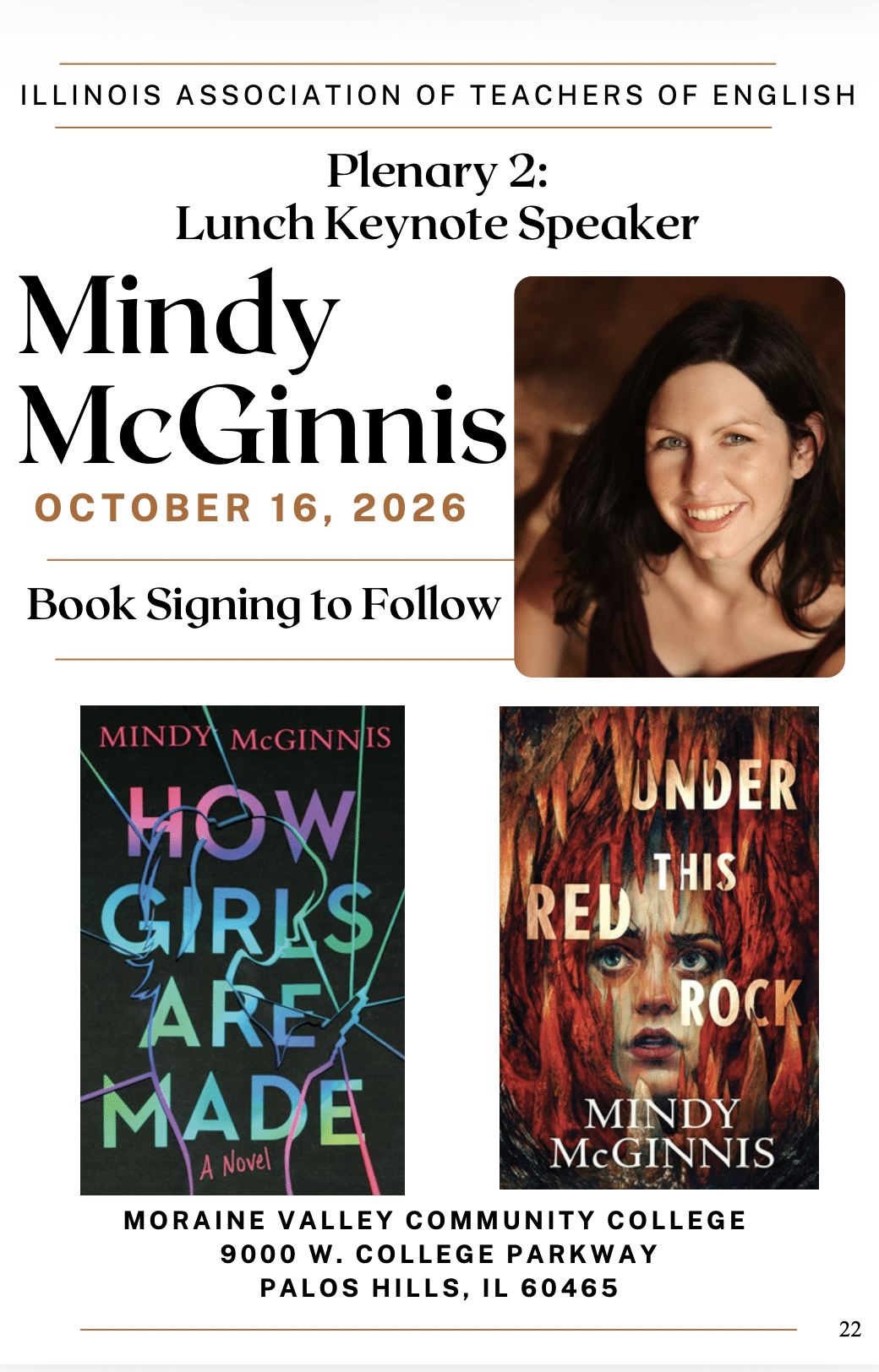
| 12:30 p.m. | Lunch keynote with author Mindy McGinnis, book signing to follow; raffle drawing |
| 3:00 p.m. | Poster Presentations C and Breakout Session C |
| 4:15 p.m. | Breakout Session D |
| 5:45 p.m. | Cocktails & Conversations |
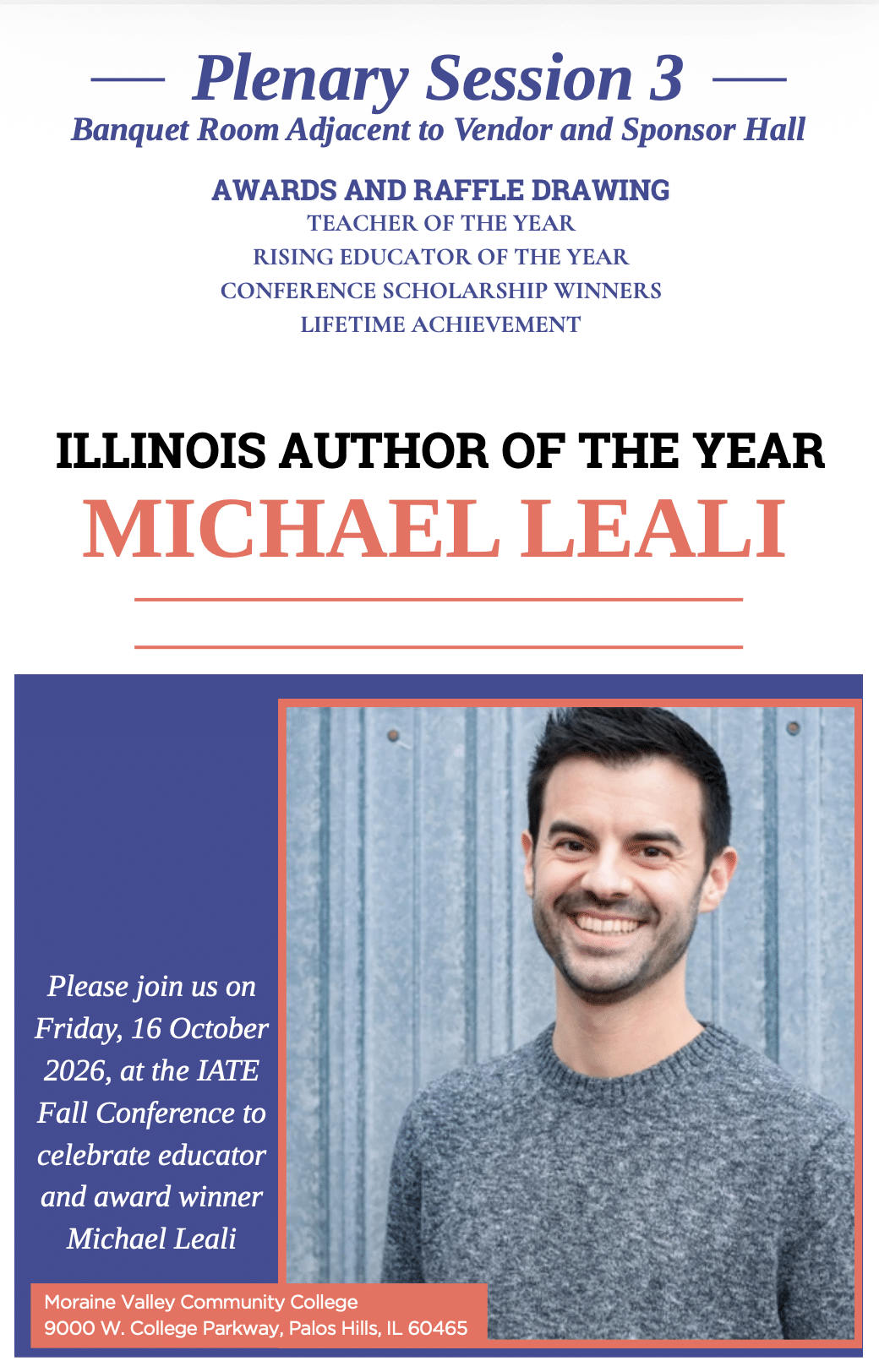
| 6:30 p.m. | Dinner and Awards, honoring 2026 Illinois Author of the Year Michael Leali; raffle drawing |
| approx. 8:45 p.m. | Informal get-together in the lobby of the Hampton Inn & Suites Burr Ridge |
| 7:30 a.m. | Registration opens; light breakfast in the Exhibition Hall |
| 8:00 a.m. | Plenary Session 4, with a Scrible presentation at 8:15 |
| 8:45 a.m. | Breakout Session E |
| 10:00 a.m. | Poster Presentations F and Breakout Session F |
| 11:15 a.m. | Poster Presentations G and Breakout Session G |
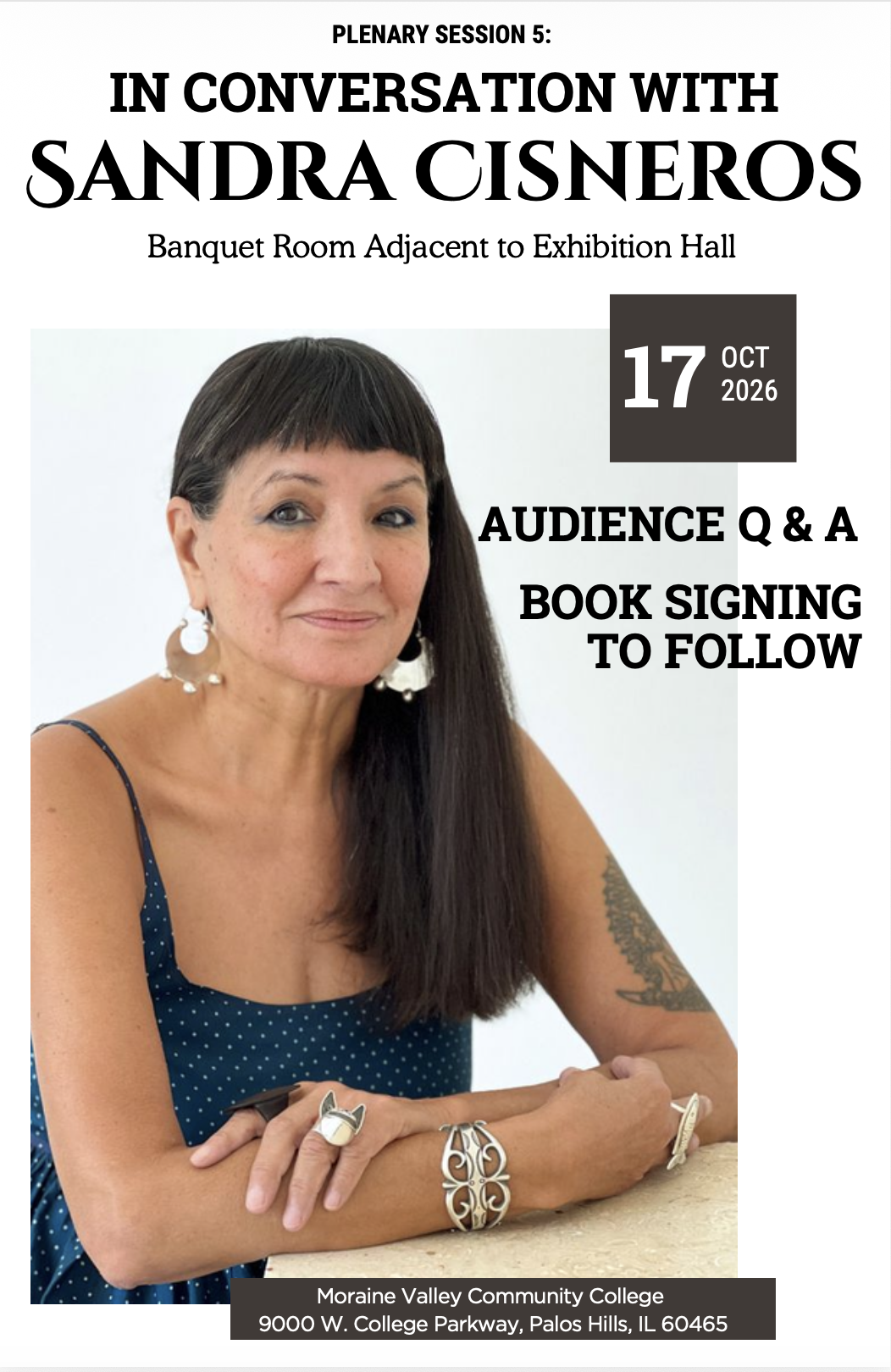
| 12:30 p.m. | Past Presidents’ Luncheon with author Sandra Cisneros |
| 3:00 p.m. | Breakout Session H (ends 4:00 or 4:30), plus a screening of the documentary Story and Pictures By in Moraine Room 1 |
Some sessions overlap because they run different lengths. See your printed program for session titles and rooms.
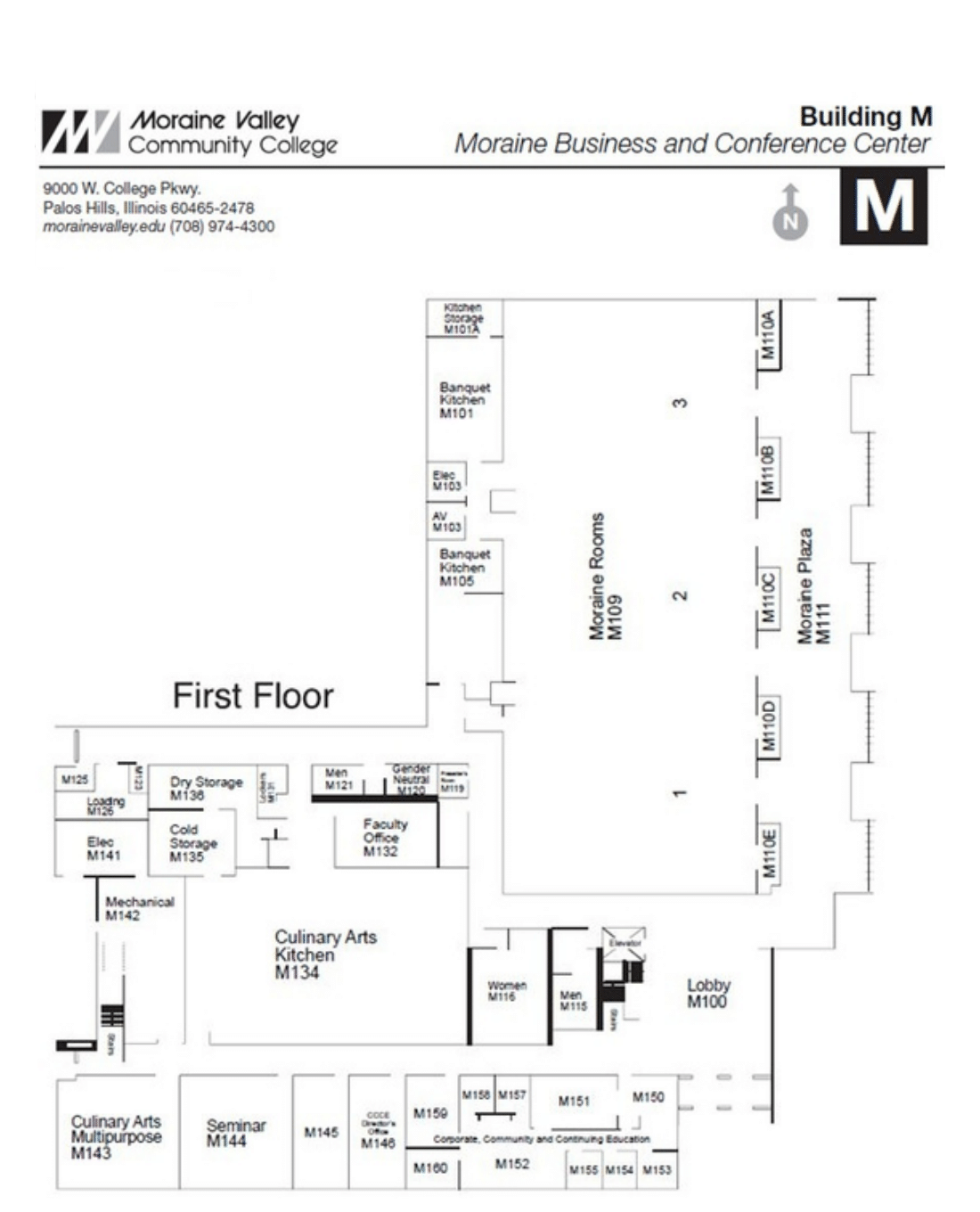
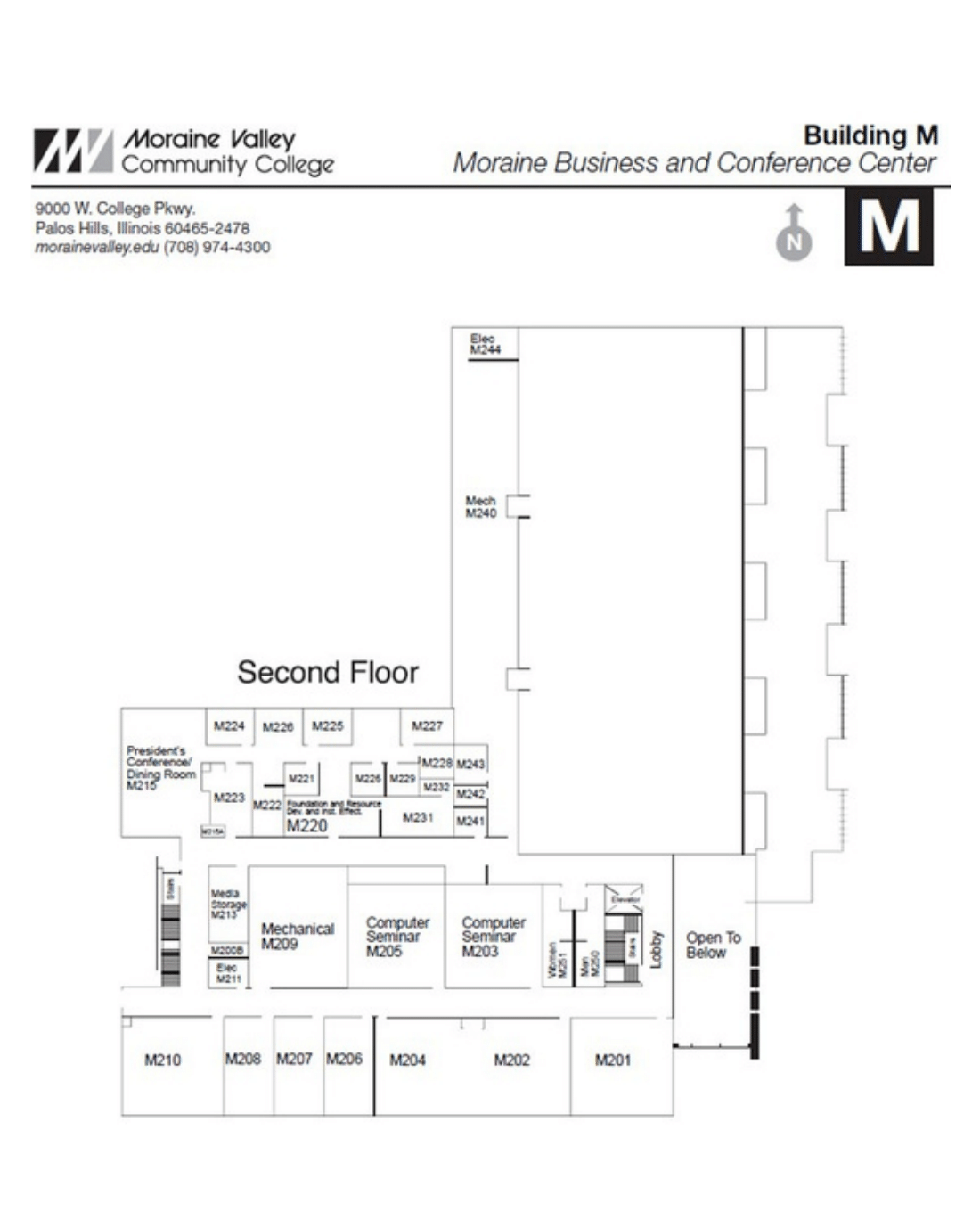
Moraine Valley’s interactive campus map lets you search for Building M and zoom in on parking lots. Buildings are identified by letter, and directional signs are posted at every campus entrance.
The campus is bounded by 107th Street on the north, 111th Street on the south, Kean Avenue on the west, and 86th/88th Avenues on the east. Because the conference center is on the south side of campus, the 111th Street entrance at College Parkway is the most convenient. If you’re on LaGrange Road (Route 45), take it to 111th Street, turn east, and go about one mile to College Parkway.
Take I-55 (Stevenson Expressway) southwest to LaGrange Road (Route 45) south. Continue south on LaGrange Road past 107th Street to 111th Street and turn left. Go about one mile and turn left into campus at College Parkway. Allow extra time for weekday-morning traffic on Friday.
Take I-55 south to LaGrange Road (Route 45) south. Continue to 111th Street and turn left, then turn left into campus at College Parkway.
Take I-355 south to I-55 north, then LaGrange Road (Route 45) south. Turn left on 111th Street, then left into campus at College Parkway.
Take I-88 east to I-294 (Tri-State Tollway) south. Exit at 95th Street and head west to 88th Avenue. Turn left on 88th Avenue; campus is on the right after 107th Street. Follow the campus signs to Building M.
Take I-57 north to I-80 west, then LaGrange Road (Route 45) north. Turn right on 111th Street, go about one mile, and turn left into campus at College Parkway.
Take I-80 east to LaGrange Road (Route 45) north. Turn right on 111th Street and turn left into campus at College Parkway.
Take I-294 north to 95th Street west, then turn left on 88th Avenue. Campus is on the right after 107th Street. Follow the campus signs to Building M.
Pace buses serve the Palos Hills campus on weekdays, so they’re mainly useful on Friday. The campus stop is outside the east entrances of Buildings S and U, a short walk from Building M.
Carpooling with colleagues? Pace RideShare is a free matching service for sharing a ride.
IATE has reserved a limited block of discounted rooms at the Hampton Inn & Suites Chicago–Burr Ridge, 100 Harvester Drive, Burr Ridge, IL 60527. Book within the IATE block here while rooms remain. After Friday’s dinner and awards, join colleagues in the hotel lobby at about 8:45 p.m. for an informal get-together.
Friday’s lunch and dinner both include raffle drawings, and winners must be present to claim their baskets.
Each session earns CPDUs, but only if you do both of the following:
Keep track of the sessions you attend in your program. All sessions must be registered in PD+ by November 30, 2026. Verification begins December 1, after which ISBE PD+ will email you a survey and your Evidence of Completion. Then enter your hours in ELIS.
Safe travels. We look forward to seeing you in Palos Hills!
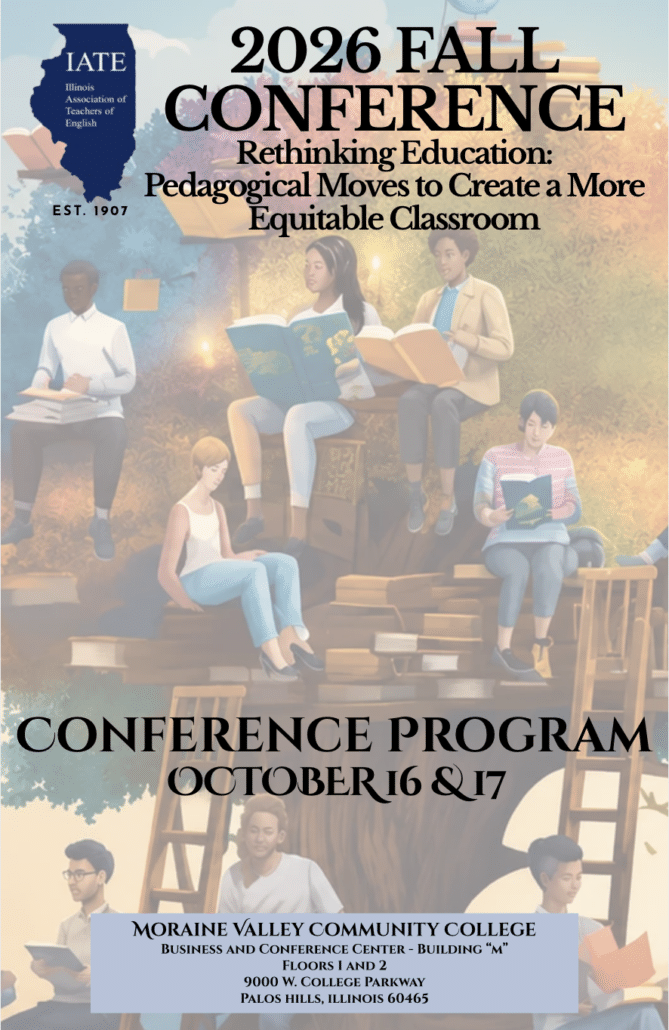
Moraine Valley Community College
October 16-17, 2026
IATE’s 2025-2026 LEADERSHIP TEAM
If you wish to pay an invoice or make a donation, please use the button below (for membership signup/renewal, please click here).